
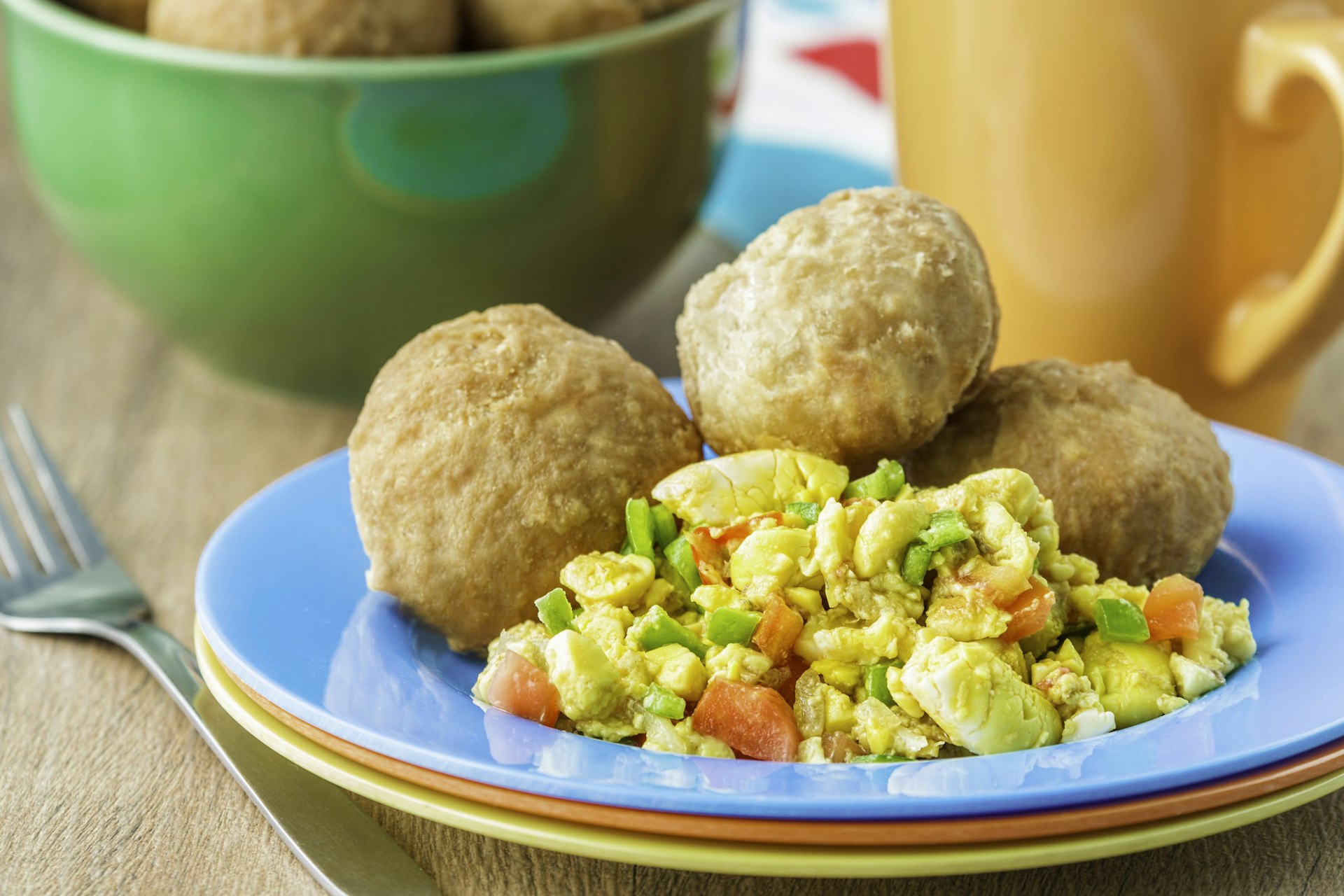
At first glance it looks like scrambled eggs. Take a bite and it is something else entirely: soft, buttery ackee folded through flakes of salty cod, onion, tomato, thyme and the warm kick of scotch bonnet. Ackee and saltfish is Jamaica’s national dish, a point of pride at home and a must-try for every visitor. Here is where it comes from, how Jamaicans cook it, and what to eat alongside it.
What is ackee and saltfish?
The dish brings together two ingredients that each travelled a long way to reach Jamaica. Ackee is a tree fruit whose creamy yellow flesh turns tender when boiled. Saltfish is salted, dried cod that is soaked or boiled to draw out the salt, then flaked. Cooked together with aromatics in a little oil, they make a savoury, colourful plate.
The Jamaica Information Service describes ackee boiled with seasoning and salt fish as “one of Jamaica’s greatest delicacies”. In 2013, the Jamaica Observer reported that National Geographic had ranked it the second-best national dish in the world.
Ackee: Jamaica’s national fruit with West African roots
Ackee is Jamaica’s national fruit, but it is not native to the island. According to the Jamaica Information Service and the Office of the Prime Minister, it was brought from West Africa, probably on a slave ship. Its name comes from “Ankye” in the Twi language of Ghana.
The government’s account records that Dr Thomas Clarke introduced ackee to Jamaica’s eastern parishes in 1778. Its botanical name, Blighia sapida, honours Captain William Bligh, who took ackee plants from Jamaica to England in 1793. Bligh is also the captain who brought the first breadfruit to Jamaica, so two of the island’s best-loved foods share a link to the same man.
The tree can grow up to about 15 metres (50 feet) tall. Its fruit is 7.5 to 10 centimetres long, and when ripe the pod splits open to show cream-to-yellow flesh, called the aril, around shiny black seeds. Jamaicans talk about two main types: “butter” ackee, with a soft yellow aril, and “cheese” ackee, which is firmer and cream-coloured.
Ackee has been planted in Trinidad, Grenada, Antigua, Barbados, Central America and Florida, but the Jamaica Information Service notes it does not grow commercially in those places. That makes the dish especially Jamaican.
Picking and cleaning ackee the Jamaican way
Ackee comes with its own kitchen wisdom, and Jamaicans follow it carefully. The government’s guidance is clear:
- Pick ackee only when it is ripe and the pods have opened naturally on the tree. Never force a closed pod open.
- Use only the yellow or cream flesh. Throw away the shiny black seeds and clean off the red or pink fibre.
- Boil it, then throw away the cooking water.
There is good reason for this care: unripe ackee, and the seeds, contain a natural compound that can make people ill. Ripe, naturally opened and properly cleaned, the Jamaica Information Service says, ackee is safe to eat. Cooks abroad can also use canned ackee, which Jamaica exports to shops serving Jamaican communities overseas.
Saltfish: a taste of the Atlantic trade
The “saltfish” half of the dish tells another story. Writing in Saveur, Bee Quammie explains that salt cod from Newfoundland and Labrador and Nova Scotia was traded to Caribbean plantation owners as cheap protein, while the prime cuts went to Europe. Saltfish became the go-to protein, and a long trade link grew between Atlantic Canada and the Caribbean.
Exactly how ackee and saltfish first met in the pot is not recorded. Saveur calls it a mystery that remains. What is certain is that Jamaicans turned two imported ingredients into a dish that now stands for the whole island.
How ackee and saltfish is cooked
Every family has its own touch, and quantities are usually judged by eye. A typical pot for four brings together:
- Saltfish, roughly a pound
- Fresh ackee from a couple of dozen pods, or a can of ackee
- An onion, a sweet pepper and a couple of tomatoes
- Garlic, fresh thyme and black pepper
- A little cooking oil
- Scotch bonnet pepper, as much or as little as you like
The method is simple:
- Freshen the saltfish first. Soak it overnight, or boil it and change the water, until it tastes pleasantly salty rather than sharp. Pick out the bones and break it into flakes.
- Boil fresh, cleaned ackee until just tender and drain it, discarding the water. Canned ackee is already cooked, so simply drain it.
- Soften the onion, garlic, sweet pepper, tomato, thyme and scotch bonnet in the oil.
- Stir in the saltfish to warm through, then turn the ackee in gently. It breaks easily, so a light hand keeps the pieces whole.
- Season with black pepper and serve hot.
What to eat with ackee and saltfish
Half the fun is choosing the sides. VisitJamaica suggests fried dumplings, callaloo, breadfruit, bammy (fried cassava cakes) and plantain. Saveur adds boiled dumplings and green bananas, or buttered hardo bread with bacon, tomato and pear, the Jamaican word for avocado.
Love ground provisions? Guyanese cooks have their own ways with them, too; browse our Guyanese recipes to cook at home. For more Caribbean classics, explore our Guyanese food guide.
Quick facts
- Dish: ackee and saltfish (also called ackee and codfish).
- Status: Jamaica’s national dish; ackee is the national fruit.
- Ackee’s botanical name: Blighia sapida, after Captain William Bligh.
- Ackee’s origin: West Africa; the name comes from the Twi word “Ankye”.
- Introduced to Jamaica: recorded in 1778.
- Two types: “butter” and “cheese” ackee.
- Classic sides: fried or boiled dumplings, breadfruit, bammy, plantain, green bananas, callaloo.
FAQ
Why is ackee and saltfish Jamaica’s national dish?
It joins Jamaica’s national fruit, ackee, with saltfish, long a staple protein in the Caribbean. Jamaica’s Office of the Prime Minister names ackee and codfish as the national dish.
Can you use canned ackee?
Yes. Jamaica exports canned ackee, and it is the easiest option for cooks overseas. It is already cooked, so drain it and fold it in gently near the end.
What does ackee taste like?
Cooked ackee is soft, mild and buttery, and its yellow colour is why the dish can look like scrambled eggs. The saltfish, thyme and scotch bonnet bring the bold flavour.
How does your family serve it: fried dumplings, breadfruit, bammy or hardo bread? Tell us in the comments.
Sources
- Jamaica Information Service: National Fruit, Ackee
- Office of the Prime Minister, Jamaica: National Fruit, Ackee
- VisitJamaica (Jamaica Tourism Board): How to Make Ackee and Saltfish like a Jamaican
- Jamaica Observer: National Geographic ranks ackee and salt fish second-best national dish (November 2013)
- Saveur: Jamaica’s National Dish Is an Immigrant to Its Own Shores
— Harpy Express Food & Flavour Desk