Last checked: November 2026
Iwokrama is a 371,000-hectare protected rainforest in the centre of Guyana, on the road between Georgetown and Lethem. You stay at Iwokrama River Lodge on the Essequibo or at Atta Rainforest Lodge by the canopy walkway, and explore with trained local guides. Plan on two or three nights.
At a glance
- Where: central Guyana, between the Essequibo and Siparuni rivers
- Getting there: by road on the Linden-Lethem route, or by small plane to a nearby airstrip
- Time needed: two to three nights; one night if you are just passing through
- Cost: varies; ask for a current quote
- Best for: rainforest birding, canopy views, night boat trips and a fair chance at jaguar
What is Iwokrama?
Iwokrama is a protected rainforest run as a test case: can a forest be conserved and still earn its keep? The idea came out of the 1989 Commonwealth Heads of Government meeting, when Guyana offered the land. The Iwokrama International Centre was set up by law in 1996 to manage it.
The forest is split into a Wilderness Preserve, left untouched, and a Sustainable Utilisation Area, where selective logging, research and tourism happen. Makushi communities of the North Rupununi are partners in its management through the North Rupununi District Development Board. Fair View village, inside the forest, holds its own land title.
It is not a national park in the usual sense. Our national parks guide explains how it fits into Guyana’s protected areas.
Where do you stay in Iwokrama?
There are two main bases, and many trips use both.
Iwokrama River Lodge sits on the Essequibo at Kurupukari, where the road crosses the river by ferry. It has eight river-facing cabins with private bathrooms, fans, verandas with hammocks and solar power. Book through the lodge or a tour operator.
Atta Rainforest Lodge sits deep in the forest on the road south, at the foot of the canopy walkway. It is run jointly by Surama village, Rock View Lodge, the Iwokrama International Centre and Wilderness Explorers. Its eight rooms are simple and private, with forest trails on the doorstep.
Stay at the River Lodge for river trips and hikes. Stay at Atta if the walkway and canopy birding are your priority.
What is the Iwokrama canopy walkway like?
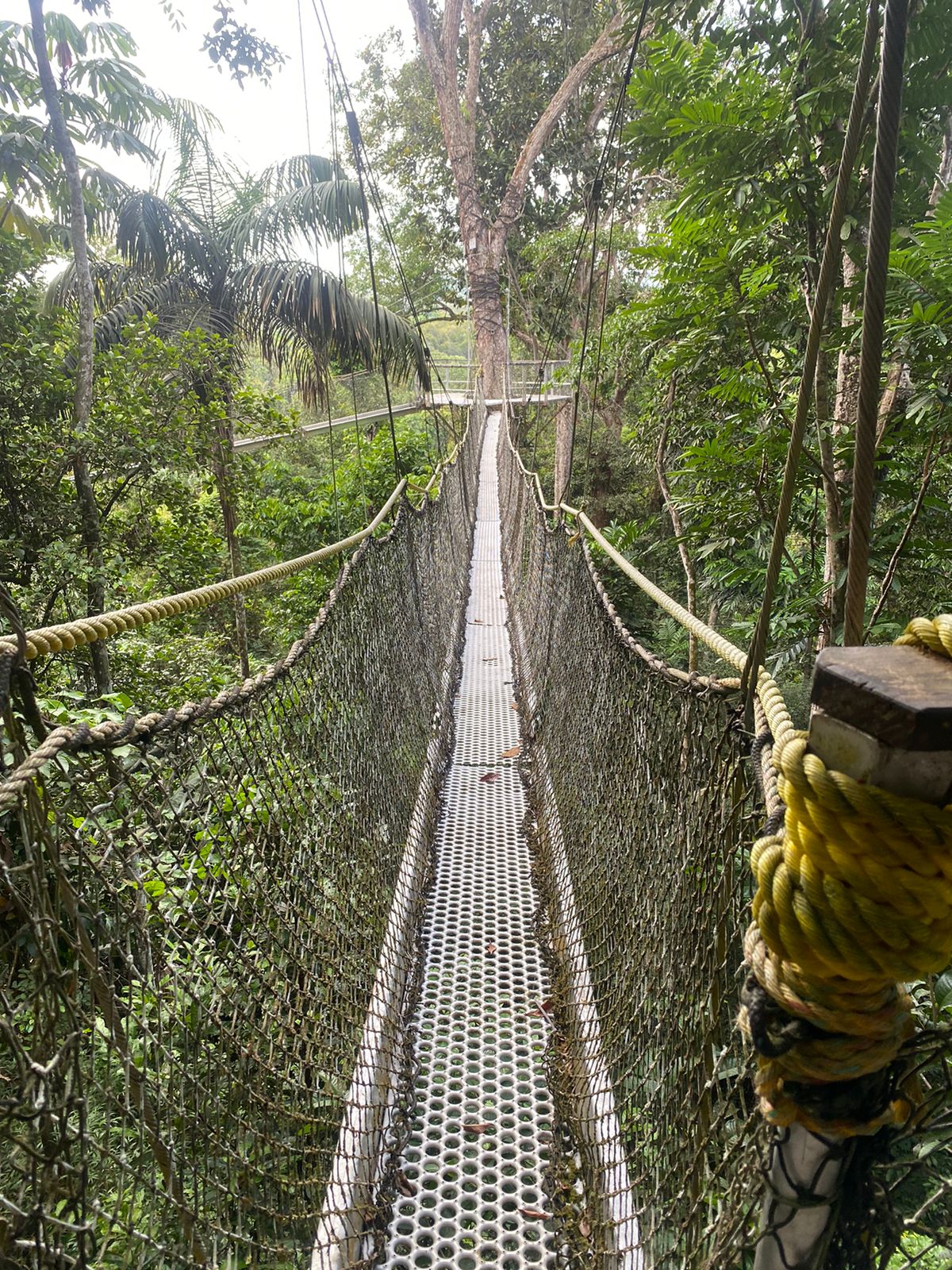
The walkway is a chain of suspension bridges and platforms in the treetops, 154 metres long and up to 30 metres high. It sits beside Atta, close to the southern edge of the forest.
From the decks you look across into the canopy instead of up at it. Dawn is best: birds and howler monkeys are active and the light is soft. Fruiting trees nearby make a big difference to what you see.
The bridges sway and you walk in small groups, so it is not for anyone with a serious fear of heights. There is an entry fee, paid on site or included in a package; ask for the current price when you book.
What else can you do at Iwokrama?
From the River Lodge, guides run:
- Turtle Mountain: a boat ride then a forest hike to a summit of about 300 metres, with views over unbroken forest. Red howler monkeys are often heard on the way.
- Night boat trips: spotlighting on the Essequibo for caiman, roosting birds and other night animals.
- Dawn boat trips: around Indian House Island for river birds.
- Short trails: the Prince Charles Nature Trail, with a side loop to a cock-of-the-rock site.
- Petroglyphs: old rock carvings near the river.
- Fishing: the Essequibo rapids near the lodge.
At Atta, the walkway is the main event, with forest walks and night walks around the lodge.
What wildlife lives in Iwokrama?
The numbers are what draw scientists. Surveys have recorded 130 mammal species in Iwokrama, 86 of them bats. More than 470 bird species have been recorded in the forest.
What you are likely to see:
- Monkeys: red howlers and black spider monkeys, especially from the walkway
- Birds: macaws, toucans, cotingas, fruitcrows and, at Atta, black curassow
- On the river: black caiman at night, river birds and, with luck, giant otters
- On the road: jaguar, usually at dawn, dusk or after dark
The road through Iwokrama has a reputation as one of the best places in Guyana to see a jaguar. Many people drive it and see nothing, so treat a sighting as a bonus.
For birders, our birdwatching guide covers the target species at each lodge. For other animals and where to find them, see our Guyana wildlife guide.
How do you get to Iwokrama?
By road: the Linden-Lethem road runs straight through the forest. The River Lodge is at Kurupukari, about halfway between Georgetown and Lethem, and buses and tour vehicles stop at the ferry. Atta is further south on the same road.
By air: small planes fly from Ogle, Georgetown, to Annai, just south of the forest, and to Lethem, from where you drive north. Ask your operator which flights run on your dates.
A common plan is to break the long Georgetown-Lethem drive with a night or two at Iwokrama. Our Rupununi travel guide covers the rest of the route.
How long should you stay at Iwokrama?
Two nights at the River Lodge gives you Turtle Mountain, a night boat trip and a dawn river trip. Add a night at Atta to do the walkway at dawn rather than in the heat of the day.
If you only pass through, a stop at the walkway in the early morning is still worth it. You will see far more with an overnight stay.
When is the best time to visit?
Iwokrama is open year-round. The drier months, roughly September to April, usually make trails and the road easier. The heaviest rain usually falls from about May to August, when the road gets muddy and slow.
Rain falls in any month, so pack for it whenever you go.
What should you pack?
- Long sleeves, long trousers and a hat for insects and sun
- Insect repellent and a rain jacket
- Closed shoes or boots with grip for wet trails
- A headlamp for night walks and boat trips
- Binoculars and a camera with zoom
FAQ
Is Iwokrama worth visiting? Yes, if you want real rainforest with good guides and simple comfort. It is the easiest place in Guyana to stay inside the forest for a few nights.
Can you see a jaguar at Iwokrama? Possibly. The road through the forest is one of the better places in Guyana for sightings, but nothing is promised.
Do I need a guide? Yes. Activities at both lodges are run with Iwokrama or community guides, and trails are not open to wander alone.
Can I do Iwokrama as a day trip from Georgetown? Not really. The drive takes most of a day each way, so plan at least one night.
Next step: Our sister company, Guyana Tours & Transportation Services, runs Iwokrama canopy walkway trips. Continuing south? Read our Rupununi travel guide.