
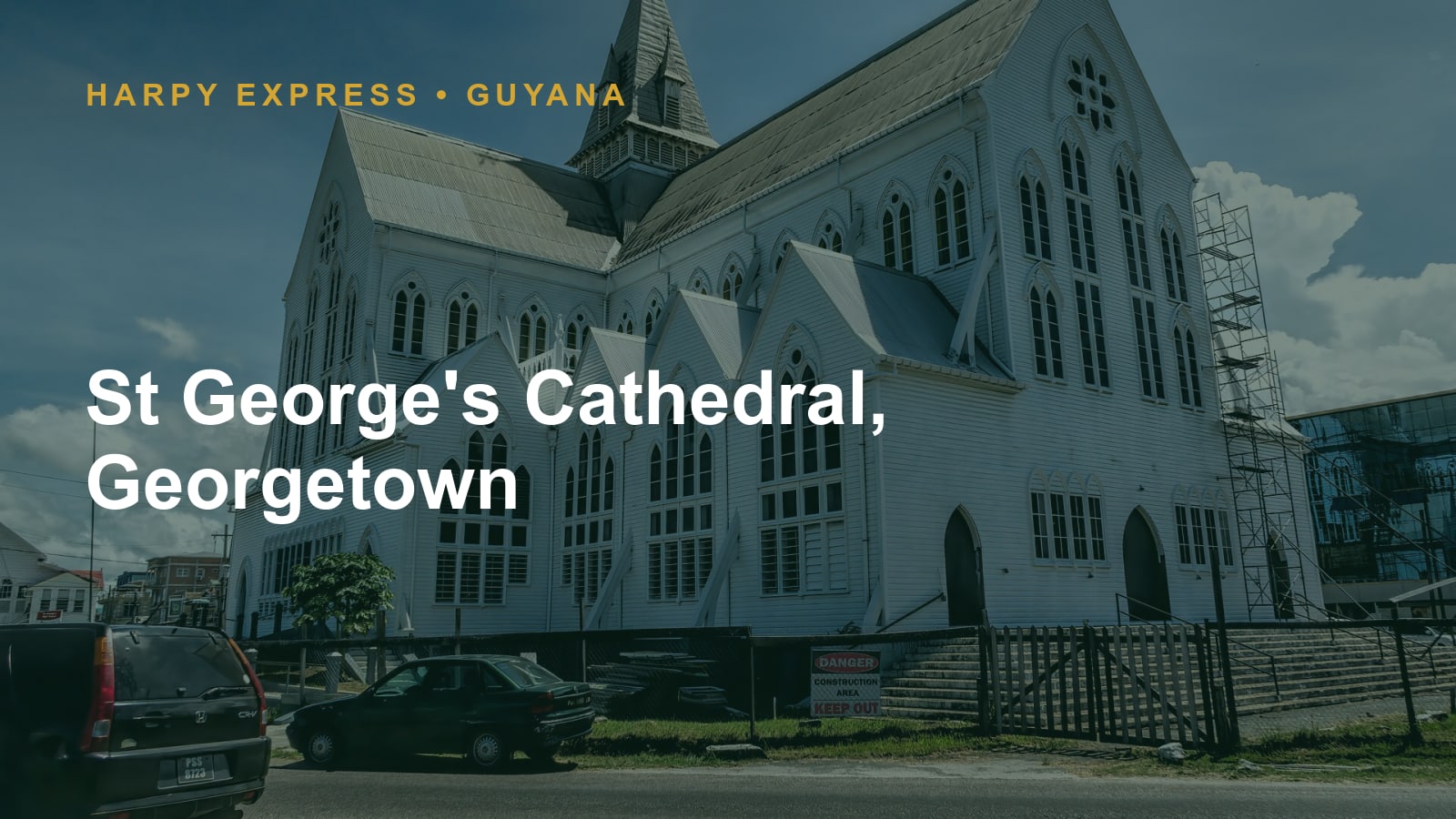
Stand at the corner of Church Street and North Road, look up, and it takes a moment to believe what you are seeing. St George’s Cathedral, Georgetown, rises about 43.5 metres (143 feet) into the sky, gleaming white, pointed and Gothic, and it is built almost entirely of wood. For more than 130 years this Anglican cathedral has been the proudest piece of Guyana’s built heritage, and it remains one of the tallest wooden churches anywhere in the world.
Here is the story of how it came to be made of timber, what to look for inside and out, how Guyanese have worked to keep it standing, and how to visit with respect.
Why St George’s Cathedral in Georgetown is made of wood
The cathedral you see today is not the first church on the site. Anglican services in Georgetown go back to 1796, when they were held in a ground-floor room on the spot where the Parliament Buildings now stand. A first St George’s church followed in 1810. It soon grew too small, and a larger church was finished in 1842. That same year the Diocese of Guiana was created and William Piercy Austin was consecrated as its first bishop, so the 1842 church became the colony’s first cathedral.
That second building had a flaw in its structure. It began to crack in several places, became unsuitable for use and was eventually taken down, and from 1877 the congregation worshipped in a temporary pro-cathedral on the Deanery grounds.
The English architect Sir Arthur Blomfield was asked to design a replacement. His first plan was for a stone cathedral with a central tower and two western towers, but it was turned down because of the weight and the cost. Blomfield’s second design kept the best of the first: the central tower, the Latin-cross layout of nave and transepts and the Gothic style, flying buttresses and all. The big change was the material. It would be timber, with a tropical touch that let in plenty of air and light.
The building committee wanted local timber first. As the Guyana Chronicle recounted in 2015, the rule was that “woods of the country and no others were to be used”. In practice, pitch pine was brought in from North America for the ceiling, but the cathedral is built mainly of greenheart, the dense, durable hardwood for which Guyana is famous.
From foundation stone to consecration
- 21 November 1889: the foundation stone was laid.
- 24 August 1892: the cathedral opened for worship, still unfinished.
- 8 November 1894: it was consecrated and dedicated by Bishop Swaby.
- 1899: the building was completed.
Blomfield never travelled to British Guiana to see the finished building, a detail shared by Carlton Joao of the restoration team and reported by Kaieteur News in 2020. He designed one of the Caribbean’s great landmarks entirely from afar, and builders in Guyana turned his drawings into greenheart.
What to look for: outside and in
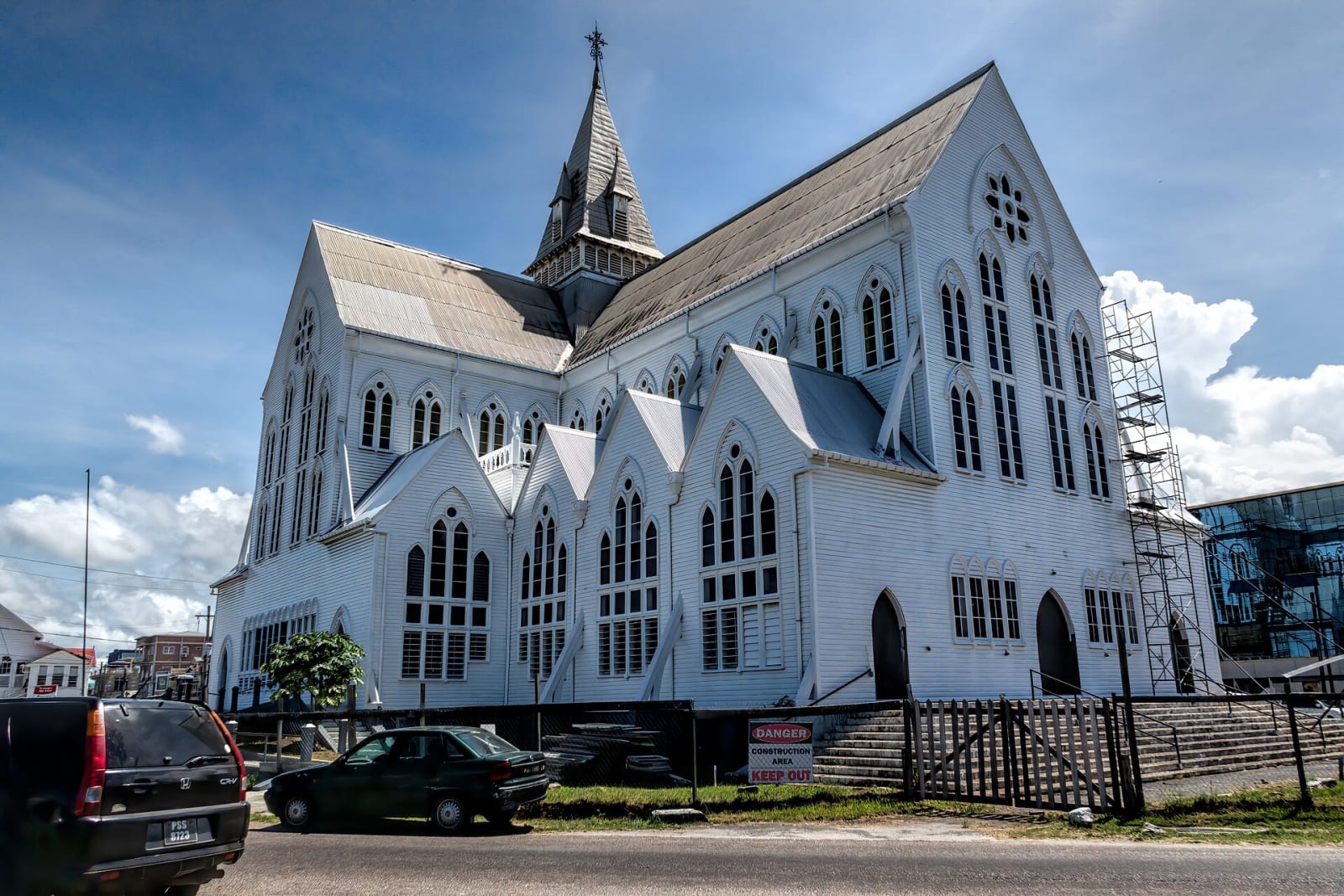
Outside, step back across the road to take in the whole shape: the tall central tower, the pointed Gothic windows and the buttresses that brace the walls. The bright white paint against a blue Georgetown sky is the classic photograph, and early morning gives the softest light (our Guyana travel photography tips explain why).
Inside, the scale is what stays with you. Writing about the interior in 2019, the Guyana Chronicle highlighted the hand-carved mouldings, stained-glass windows, Gothic arches, clustered columns, the arched ceiling and the built-in organ with its pipes. Because the cathedral is a national monument, the interior is meant to stay true to the original design. Bishop Charles Davidson explained in the same report that changes need the National Trust’s permission.
Take your time, look up, and notice how much of what surrounds you was shaped by hand from Guyanese wood.
A national monument
St George’s is one of Guyana’s gazetted national monuments, cared for under the National Trust of Guyana. It shares that short list with Fort Zeelandia and the Court of Policy, Fort Kyk-Over-Al, Fort Nassau, State House, the Red House, the Umana Yana and the African Liberation Monument, the 1763 Monument and the Non-Aligned Monument. The cathedral is also the seat of the Anglican Bishop of Guyana, so it is a working church as well as a heritage site.
Restoring a wooden giant
Timber in a hot, wet climate needs constant care, and by the 2010s the cathedral was due for serious work. In April 2015 the Diocese launched a Cathedral Restoration Appeal at the cathedral’s patronal festival. Dean Paul Andrew Carto said engineering studies had been done, that the full job was estimated at about US$2 million, and the Diocese’s trustees presented a G$100 million cheque to start. An assessment by TVA Consultancy, a firm from Grenada, had found the building worth restoring and preserving.
The main works began in 2017. Suppliers included Iwokrama/McVantage and Farfan & Mendes, the National Trust contributed, and friends of the cathedral such as Banks DIH helped the Diocese’s trustees fund the job. On 17 October 2020 the major phase was finished: the north, south and west walls and the surrounding lower roofs had been restored after about four years and some G$200 million of work, as reported by Stabroek News and Kaieteur News. Mass was celebrated in the refreshed cathedral the next day.
The one big job left at that point was the main roof, including the ceiling. In November 2020 Bishop Davidson told the Guyana Chronicle it could need a further G$150 million to G$175 million. We could not find a published update on the main roof as of November 2026, so ask at the cathedral if you would like the latest or want to help.
How to visit St George’s Cathedral
- Where: where Church Street meets North Road in central Georgetown, a short walk from Stabroek Market and the Company Path garden with the Non-Aligned Monument.
- It is a church first. Services and private prayer come before sightseeing. Dress modestly, keep your voice low and don’t wander about during a service.
- Visiting hours vary. We could not confirm regular visiting hours as of November 2026. The surest way to see the inside is to attend a Sunday service as a guest, or to ask at the cathedral office in advance.
- Photography: the outside is easy to photograph from the street. Ask before taking pictures inside, and never during worship.
- Make a morning of it: pair the cathedral with the markets and landmarks in our guide to things to do in Georgetown, or build it into a longer trip with 3 Days in Guyana.
Quick facts
- Name: St George’s Cathedral (Anglican)
- Location: Church Street and North Road, Georgetown, Guyana
- Architect: Sir Arthur Blomfield
- Main timber: greenheart (imported pitch pine ceiling)
- Height: about 43.5 metres (143 feet)
- Foundation stone: 21 November 1889
- Consecrated: 8 November 1894
- Status: national monument and seat of the Anglican Bishop of Guyana
- Latest major restoration: 2017 to October 2020 (walls and lower roofs)
Frequently asked questions
Is St George’s Cathedral the tallest wooden church in the world?
It is widely described as one of the tallest wooden churches in the world, at about 43.5 metres (143 feet). Taller timber churches have been built elsewhere since, so “one of the tallest” is the accurate way to put it.
Why wasn’t it built of stone?
Blomfield’s first stone design was rejected because it was too heavy and too expensive. His timber design kept the Gothic look while using local greenheart.
Can visitors go inside?
Yes, but it is an active cathedral and arrangements change. Joining a Sunday service or contacting the cathedral office ahead of time is the most reliable way to see the interior.
Sources
- Guyana Chronicle: St George’s Cathedral restoration project receives G$100M cheque (27 April 2015)
- Guyana Chronicle: The St George’s Cathedral (20 October 2019)
- Kaieteur News: Major restoration phase of iconic St George’s Cathedral completed (19 October 2020)
- Stabroek News: Major rehab of St George’s Cathedral completed (2 November 2020)
- Guyana Chronicle: At least $150M needed for restoration of main roof (3 November 2020)
- Guyana Times International: Guyana’s National Monuments
— Harpy Express Guyana Desk