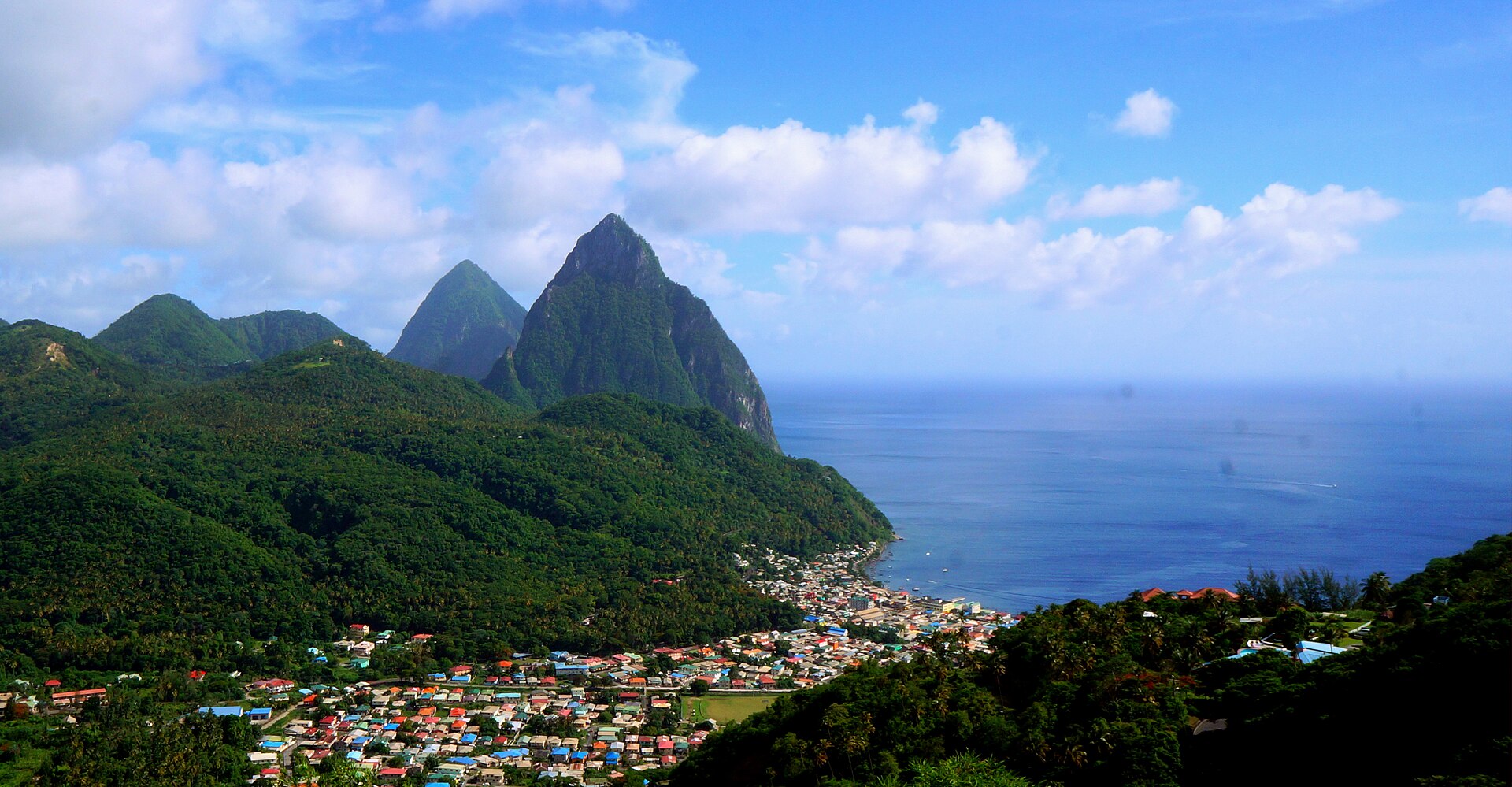
Sail down Saint Lucia’s southwest coast and two forest-covered spires climb straight out of the Caribbean Sea, side by side, as if the island had raised two fingers to the sky. These are the St Lucia Pitons, Gros Piton and Petit Piton, the old volcanic peaks near the town of Soufrière that UNESCO says are “visible from virtually every part of the island”. They are Saint Lucia’s best-known landmark, a World Heritage Site since 2004, and home to one of the most rewarding climbs in the Eastern Caribbean.
This guide covers what makes the Pitons special, how to hike them (and which peak suits you), the easier viewpoint for everyone else, and the hot springs, gardens and reefs that share the same protected area.
What are the St Lucia Pitons?
The Pitons are two steep volcanic spires standing next to each other on the coast just south of Soufrière, joined inland by a ridge called Piton Mitan. Gros Piton is the bigger and broader of the two; Petit Piton is slimmer, steeper and closer to town.
Their heights depend on who you ask. UNESCO lists Gros Piton at 770 metres and Petit Piton at 743 metres. The Saint Lucia Tourism Authority gives Gros Piton as 798 metres (2,619 feet) and Petit Piton as 743 metres (2,438 feet). Every source agrees on the order: Gros Piton is the taller twin.
Geologically, they are what is left of a much bigger volcano. UNESCO explains that the area holds most of a collapsed stratovolcano within what geologists call the Soufrière Volcanic Centre. Around the two peaks you will also find lava domes, explosion craters, layers of pumice and ash, and old lava flows, a full record of how this part of the island was built. Petroglyphs and other artefacts in the area also point to the Amerindian people who lived here long before Europeans arrived.
A World Heritage Site where people live and work
UNESCO inscribed the Pitons Management Area on the World Heritage List in 2004. The site covers 2,909 hectares of land and sea near Soufrière, and it is not a fenced-off park. Slightly more than half of the land belongs to the government and the rest is privately owned, and about 1,500 residents live within its multiple-use zones, farming, fishing and running small businesses alongside the conservation areas.
For such a small area, the nature count is impressive. Surveys have recorded at least 148 plant species on Gros Piton and 97 on Petit Piton and the ridge between them, including eight rare tree species. Gros Piton alone is home to about 27 bird species, five of them found only in Saint Lucia, and the highest slopes carry patches of misty elfin woodland.
The protection carries on underwater. The Soufrière Marine Management Area, set up in 1994, is the marine part of the World Heritage Site: a strip of coast roughly 11 kilometres long and about one kilometre wide, where coral reefs cover around 60 per cent of the seabed. Surveys have counted 168 species of fish, hawksbill turtles are seen close to shore, and whale sharks and pilot whales pass further out.
Hiking Gros Piton: the classic climb
Gros Piton is the climb most visitors mean when they talk about “doing the Pitons”. The Saint Lucia Tourism Authority describes it as a round trip of about 4 kilometres that usually takes four to six hours, rated moderate to challenging. A certified local guide is required.
The walk starts at the Gros Piton Nature Trail, south of Soufrière, in the community of Fond Gens Libre, where hikers meet their guide at the interpretive centre. The guides’ own site says the settlement dates back to the 1700s and that people escaping slavery sought refuge in these mountains during the island’s 1748 rebellion. Many of today’s guides come from the community, so the history comes with the hike.
Expect two halves. The first stretch winds gently around the base of the mountain with views over the sea. The second half turns steep and rocky, with tall volcanic steps where a walking stick or a helping hand on a boulder makes a real difference. Coming down can be harder on the knees than going up, especially after rain.
The reward is a near 360-degree view over southern Saint Lucia. The guides’ site says that from the top you can pick out Soufrière and Vieux Fort, and on a clear day the island of St Vincent on the horizon.
Start early, while it is cool. The tourism authority’s packing list is a good one to follow:
- Hiking boots or trainers with a strong grip
- Light, breathable clothes and a rain jacket
- At least 2 litres of water per person, plus energy snacks
- Sunscreen and insect repellent
- A small backpack, and a walking stick for muddy sections
If you are combining a rainforest hike with beach days on the same trip, our Caribbean packing list for rainforest and beach shows how to fit both into one bag.
Petit Piton: for experienced scramblers only
Petit Piton is shorter but far more demanding. The tourism authority calls it a technical scramble rather than a standard hike: about 3.2 kilometres round trip, three to five hours, with fixed ropes to help you up near-vertical rock faces and exposed sections along the way. It is rated very challenging, and a professional guide is mandatory.
This one is for confident climbers with a head for heights. Wet rock makes any scramble riskier, so talk to your guide about the weather before you set off, and be ready to switch to Gros Piton or a lower trail if conditions are poor.
Tet Paul Nature Trail: Piton views without the summit
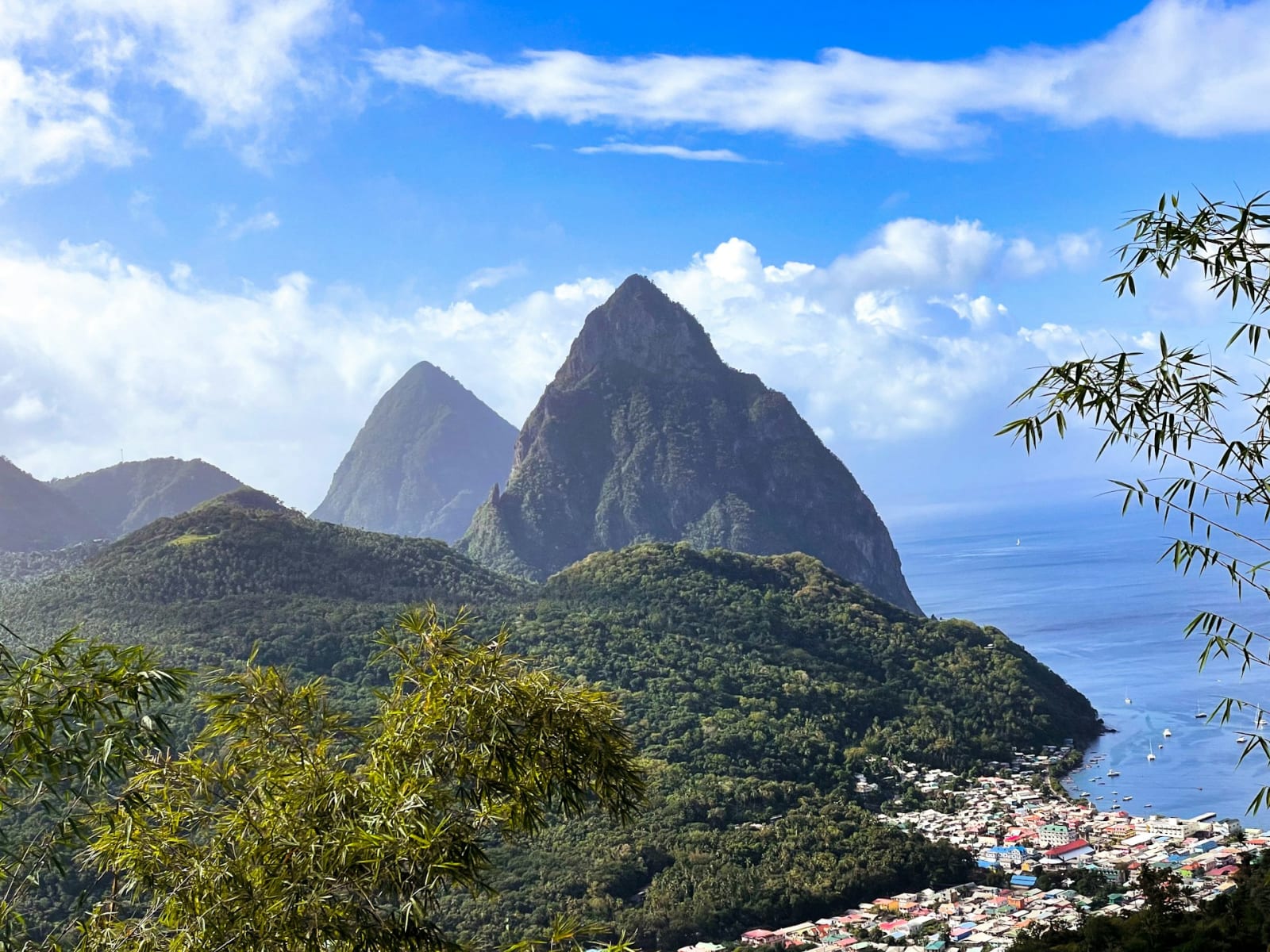
Not everyone wants a five-hour climb, and you do not need one to see the Pitons up close. The Tet Paul Nature Trail, a short, family-run trail near Soufrière that the tourism authority lists among the island’s hikes, takes most walkers well under an hour. It finishes at a hilltop lookout known as the “Stairway to Heaven”, with both peaks lined up in front of you. It is a good choice for families, older travellers or anyone short on time.
Sulphur Springs, mineral baths and reefs
The Pitons sit on top of a living volcanic system, and you can see it in action at Sulphur Springs, which lies inside the World Heritage area. The tourism authority describes it as often called the Caribbean’s only drive-in volcano: you can drive right into the geothermal zone, then follow a short guided route past steaming vents and bubbling mud pools. Next door, the mud baths let you coat yourself in grey volcanic mud and rinse off in warm spring water.
For something calmer, the Diamond Falls Botanical Gardens and Mineral Baths are fed by the same geothermal springs. According to the tourism authority, the warm baths were once used by French troops, and the gardens around them are a gentle way to spend an afternoon.
Back at sea level, the reefs of the Soufrière Marine Management Area make the Pitons coast a popular place to snorkel and dive, with the peaks rising straight above you as you float.
Planning your Pitons day
- Base yourself in or near Soufrière. It puts the trailheads, the springs and the reefs within a short drive. Sulphur Springs is about 45 minutes by car from Hewanorra International Airport, according to the tourism authority.
- Climb in the morning, soak in the afternoon. A Gros Piton hike followed by Sulphur Springs or the mineral baths is a classic Soufrière day. The tourism authority suggests visiting the springs in the morning or late afternoon, when it is cooler and quieter.
- Book a certified guide. Guides are required on both Pitons. Your hotel or the trail office can arrange one.
- Check fees on the day. As of November 2026, the tourism authority does not publish trail or park entry fees, so confirm current prices and opening hours directly before you go.
- Leave it as you found it. Stay on marked trails, carry your rubbish out and do not pick plants. This is a protected site that people also call home.
Planning a December visit? Pair your Pitons trip with the lanterns and fireworks of Saint Lucia National Day on 13 December. And if you are collecting OECS islands, our Grenada Spice Isle guide has more crater lakes and waterfalls to add to the list.
Quick facts
- Where: Southwest coast of Saint Lucia, near Soufrière
- Heights: Gros Piton 770 m (UNESCO) or 798 m (tourism authority); Petit Piton 743 m
- World Heritage Site: Pitons Management Area, inscribed 2004, 2,909 hectares
- Gros Piton hike: about 4 km round trip, 4–6 hours, guide required
- Petit Piton climb: about 3.2 km round trip, 3–5 hours, fixed ropes, guide mandatory
- Easier option: Tet Paul Nature Trail, under an hour, views of both peaks
- Nearby: Sulphur Springs, Diamond Falls mineral baths, Soufrière Marine Management Area
FAQ
Do I need a guide to hike the Pitons?
Yes. The Saint Lucia Tourism Authority says a certified local guide is required for both Gros Piton and Petit Piton. Guides know the trail, the weather and the history, and on Gros Piton they meet you at the trail’s interpretive centre in Fond Gens Libre.
Which Piton is easier to climb?
Gros Piton, even though it is taller. It follows a marked trail rated moderate to challenging, while Petit Piton is a steep scramble with fixed ropes on near-vertical rock that the tourism authority rates very challenging.
Can I see the Pitons without hiking?
Absolutely. The peaks are visible from much of the island and from boats along the west coast. For a close-up view with little effort, the Tet Paul Nature Trail near Soufrière takes under an hour and ends at a lookout facing both Pitons.
Sources
- UNESCO World Heritage Centre: Pitons Management Area
- UNESCO World Heritage Committee decision 28 COM 14B.11 (2004 inscription)
- Saint Lucia Tourism Authority: Hiking the Pitons
- Saint Lucia Tourism Authority: Sulphur Springs
- Saint Lucia Tourism Authority: Rainforest Hikes and Trails
- Gros Piton Climb (Gros Piton Nature Trail guides)
— Harpy Express Barbados & OECS Desk