Georgetown in the morning, Paramaribo by nightfall. Travelling from Guyana to Suriname by road is one of the great overland journeys of the Guianas: a long drive down the Corentyne coast, a river crossing between two countries, and a fast run along Suriname’s coastal highway to its colourful capital. You see far more than from a plane window, and you arrive with a real sense of how closely these two neighbours are tied together.
This guide walks you through each leg, the papers you need and what to check before you leave. Rules, schedules and vessels change, so everything below is as of November 2026.
Guyana to Suriname by road: the route at a glance
The journey has three parts:
- Georgetown to Moleson Creek (Guyana): east along the coast, over the Berbice River Bridge, through New Amsterdam and down the Corentyne to the ferry terminal.
- Moleson Creek to South Drain: the official ferry across the Corentyne River, with immigration on both banks.
- South Drain to Paramaribo (Suriname): north to Nieuw Nickerie, then east along the East-West road to the capital.
Plan on a full day and start early. The ferry crossing itself is short, but the drive on each side, plus two sets of border formalities, fills the hours.
Leg 1: Georgetown to Moleson Creek
From Georgetown, head east along the East Coast and across the Berbice River into New Amsterdam, then follow the Corentyne Highway through the rice and cane villages of Region Six. Good news for drivers: the Berbice River Bridge, once the priciest crossing in the country, has been toll-free since 1 August 2025, along with Guyana’s other tolled bridges.
Corriverton (Springlands) is the last town of any size, and a good place for a breakfast stop and to pick up snacks and water. The Moleson Creek ferry terminal sits about 10 km south of Corriverton, on the bank of the Corentyne River.
How to get there:
- Minibus and hire car: minibuses run from Georgetown towards Moleson Creek and the Corentyne. Early-morning departures are best, so you reach the terminal in good time for a crossing. Agree the drop-off point (the ferry terminal itself) before you set off.
- Private transport: for families, groups with luggage or anyone who wants a door-to-door start, a private driver takes the guesswork out of timing. Guyana Tours offers private transportation in Guyana; ask about a drop-off at the terminal.
- Your own car: Guyana and Suriname both drive on the left. If you plan to take a vehicle across, check customs and insurance requirements on both sides well before travel.
Leg 2: the Corentyne River crossing
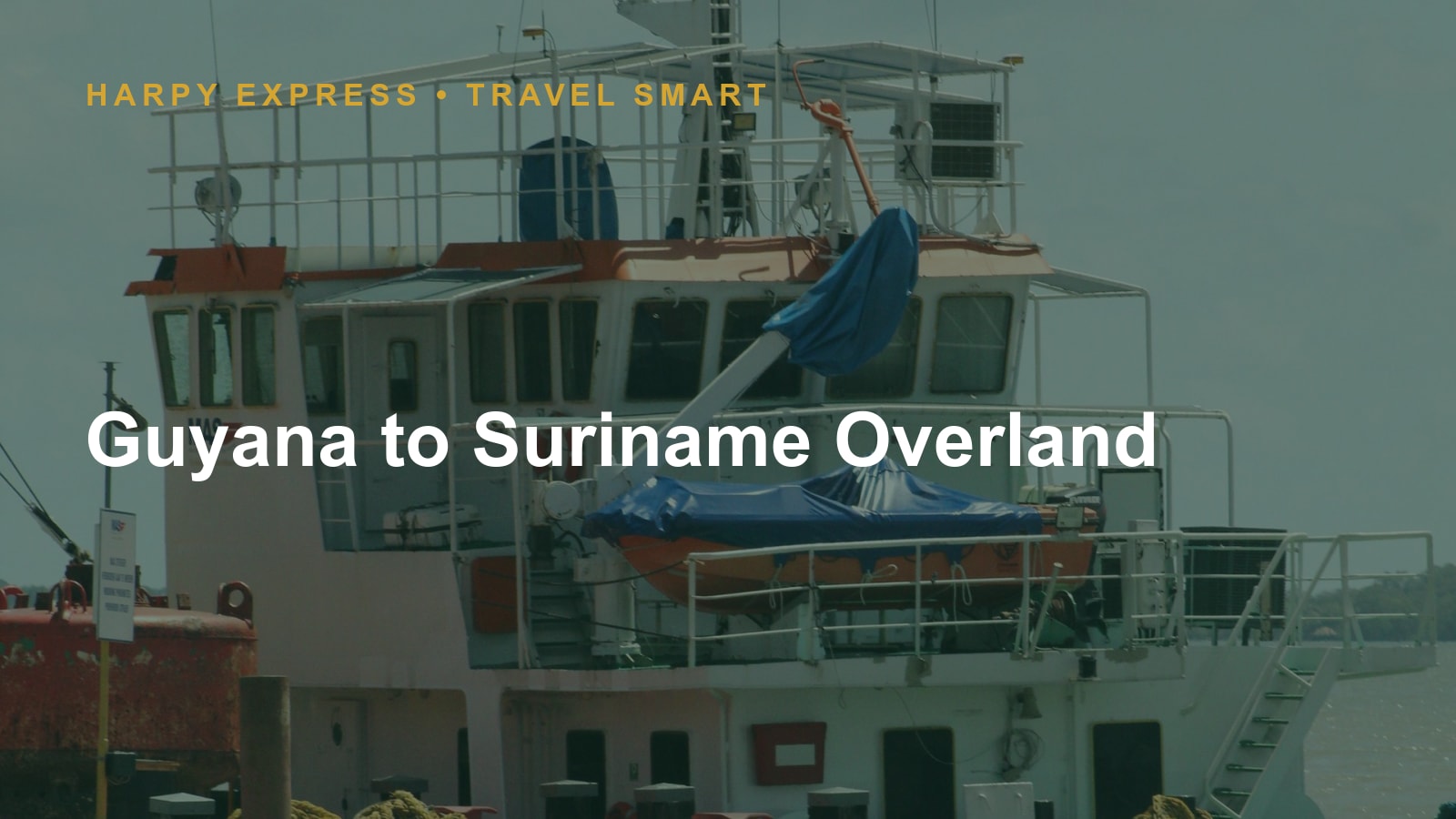
The crossing between Moleson Creek and South Drain is the one official ferry link between the two countries. The service is run through a company owned in equal shares by the governments of Guyana and Suriname, and it has operated since 1998.
Which boat is running right now? The regular ferry, the MV Canawaima, went into dry dock on Saturday 7 November 2026. To keep the crossing open, the Government of Guyana put the MB Sandaka into service the same day to carry passengers and cargo between Moleson Creek and South Drain. No return date for the Canawaima had been announced at the time of writing, so check the latest news before you set out, especially if you are travelling with a vehicle.
At the terminal:
- Arrive early. You clear Guyana immigration at Moleson Creek before boarding, and you need your passport to buy a ticket.
- Ticket prices and departure times are not published on an official website as of November 2026. Confirm both at the Moleson Creek terminal, or ask your driver to call ahead, and carry some cash.
- On the far bank you clear Suriname immigration and customs at South Drain.
What you need to enter Suriname
Entry rules depend on your passport. As of November 2026, Suriname’s official Immigration/Customs Form (ICF) website sets out three groups:
- CARICOM passport holders (including Guyanese) do not need an Entry Fee or e-Visa.
- Most other nationalities, including visitors with UK, US and Canadian passports, pay an Entry Fee. The government set the fee at US$50 or €50 per entry. You can pay it on arrival, or in advance (plus a service charge) through the official VFS Global portal for Suriname.
- A list of about 20 countries needs an e-Visa instead. Check the ICF site to see if yours is one of them.
Everyone should also fill in the online ICF (Immigration/Customs Form) at icf.sr before travel. The ICF site is written mainly for air travellers, so it does not spell out how the form is checked at South Drain, but completing it in advance and keeping the QR code on your phone can save time. Each traveller, children included, fills in their own form.
Two more points from Suriname’s customs guidance: declare what you are carrying, and do not carry US$10,000 or more in cash (or the equivalent) across the border, which Suriname’s rules do not allow.
Leg 3: South Drain to Paramaribo
From South Drain, a paved road of about 30 km runs north to Nieuw Nickerie, the main town of the Nickerie district and its rice polders. From there the coastal East-West road (Oost-West Verbinding) runs east all the way to Paramaribo, roughly 235 km, or around four hours of driving.
Your options on the Suriname side:
- Bus: state buses and private minibuses run between Nieuw Nickerie and Paramaribo. Ask at South Drain about transport for the 30 km or so into Nieuw Nickerie.
- Through transport: booking a driver on each side of the river, to meet you at the terminals, is the simplest way to move a family and luggage.
- Break the journey: if you crossed in the afternoon, Nieuw Nickerie makes an easy overnight stop. The town’s sea wall and the nearby Bigi Pan nature reserve, a vast area of open water, mudflats and mangroves, reward a slower start next morning.
Once you are in Suriname, remember that the currency is the Surinamese dollar (SRD) and that Suriname is one hour ahead of Guyana, so adjust your watch and your plans for bus departures.
Tips for a smooth crossing
- Check the ferry status the day before. Government notices (DPI in Guyana) and national newspapers announce changes to the service.
- Keep documents in one place: passport, Entry Fee voucher or e-Visa if you need one, ICF QR code, and any vehicle papers.
- Carry small cash in both currencies for tickets, snacks and onward transport.
- Pack light for the river: a small day bag with water, a hat and sunscreen makes the wait and the crossing more comfortable. Our Caribbean packing list has more ideas.
- Time it with an occasion. Suriname’s Independence Day, Srefidensi, falls on 25 November. Our Srefidensi guide explains how Paramaribo celebrates.
The mainland connection
This crossing is a reminder that Guyana is the Caribbean’s mainland gateway: from Georgetown you can reach Suriname by road and river, and keep going east towards French Guiana. The two governments have also discussed a bridge of about 3.1 km over the Corentyne between Moleson Creek and South Drain, landing on Long Island in the river. As of November 2026, the ferry remains the way across.
If you are planning the Guyana side of your trip first, see our guide to the best places to visit in Guyana and the best time to visit Guyana.
Quick facts
- Border crossing: Moleson Creek (Guyana) to South Drain (Suriname), across the Corentyne River
- Vessel as of November 2026: MB Sandaka, covering while the MV Canawaima is in dry dock (from 7 Nov 2026)
- Moleson Creek: about 10 km south of Corriverton
- Berbice River Bridge: toll-free since 1 August 2025
- Entry for CARICOM nationals: no Entry Fee or e-Visa (as of November 2026)
- Entry Fee for most other visitors: US$50 / €50, on arrival or in advance online (as of November 2026)
- Nieuw Nickerie to Paramaribo: roughly 235 km on the East-West road
- Currency in Suriname: Surinamese dollar (SRD)
FAQ
Can you drive from Guyana to Suriname?
Yes, but not all the way on land. You drive to Moleson Creek, cross the Corentyne River by ferry to South Drain, and continue by road to Nieuw Nickerie and Paramaribo. If you plan to take your own vehicle across, confirm customs and insurance requirements on both sides, and check that the vessel running on your travel date carries vehicles.
Do Guyanese need a visa or Entry Fee for Suriname?
No. As of November 2026, Suriname’s ICF website lists holders of CARICOM passports, including Guyanese, among those who do not need an Entry Fee or e-Visa. You still need a valid passport, and filling in the online ICF in advance is a sensible step.
How long does the trip from Georgetown to Paramaribo take?
Plan for a full day. The drive to Moleson Creek, the wait and ferry crossing with immigration on both sides, and roughly four hours on the road from Nieuw Nickerie to Paramaribo all add up. An early start from Georgetown gives you the best chance of reaching Paramaribo the same evening.
Sources
- Government of Guyana press release: MB Sandaka to facilitate transportation during MV Canawaima dry docking (6 Nov 2026)
- Guyana Chronicle: MB Sandaka to continue ferry service between Guyana, Suriname (6 Nov 2026)
- Ministry of Public Works, Guyana: Canawaima Management Company
- ICF Suriname: ICF Requirements (Entry Fee and e-Visa)
- ICF Suriname: FAQ
- Government of Suriname, Ministry of Foreign Affairs: Entry Fee adjustment announcement
- Kaieteur News: Berbice River Bridge tolls removed from 1 August 2025 (21 Aug 2025)
- Kaieteur News: Moleson Creek ferry location (29 Dec 2017)
- Guyana Chronicle: Corentyne River bridge (2 Jul 2026)
- Wikivoyage: West Coast (Suriname) (road distance, buses, Bigi Pan)
— Harpy Express Travel Smart Desk