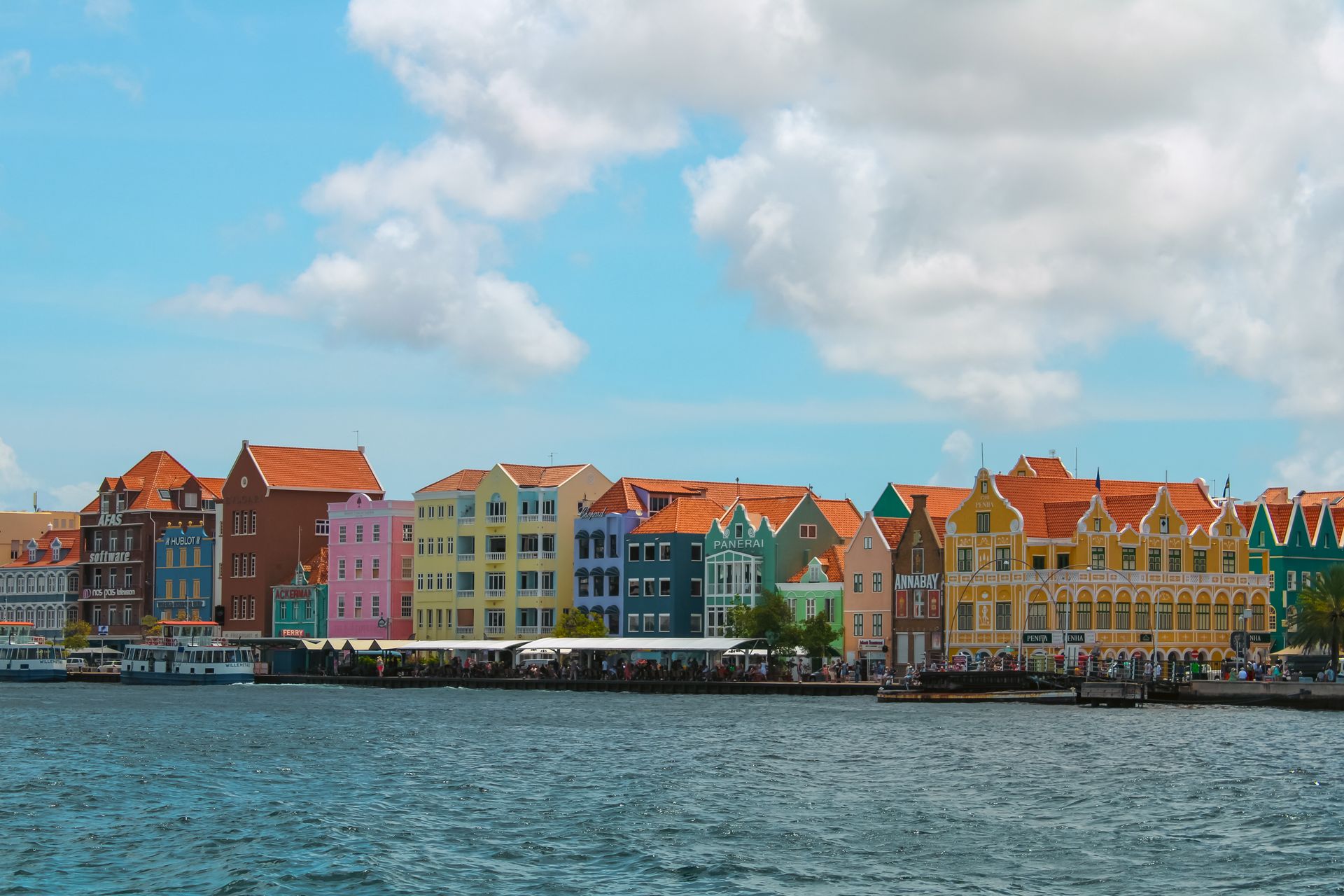
Picture a waterfront lined with gabled houses painted in red, blue, yellow ochre and green, and a long bridge that swings out of the way so ocean ships can pass. That is Willemstad, Curaçao, the capital of the island locals lovingly call Dushi Korsou. It is one of the most photographed cities in the Caribbean, and its historic heart has been a UNESCO World Heritage Site since 1997.
This is our Island of the Week: a friendly introduction to Willemstad for anyone in the English-speaking Caribbean who has seen the photos and wondered what is behind all that colour.
Willemstad, Curaçao at a glance
Curaçao sits in the southern Caribbean and is an autonomous country within the Kingdom of the Netherlands. It became a separate country inside the Kingdom on 10 October 2010. Willemstad is its capital and largest city.
The story of the city begins in 1634, when the Dutch set up a trading settlement at the island’s fine natural harbour. Construction of Fort Amsterdam began that same year on the eastern bank of Sint Anna Bay. The fort still has an official role today as the location of the Governor’s residence. Two more forts, Water Fort and Rif Fort, were added in the late 1820s.
UNESCO lists the old city as the Historic Area of Willemstad, Inner City and Harbour, Curaçao. It describes a European architectural style with regional adaptations, finished in a rich array of Caribbean colours. The Curaçao Tourist Board counts more than 700 protected historic buildings, and notes that Willemstad is one of only five Caribbean capitals on the World Heritage list.
Why the buildings are so colourful
Willemstad’s rainbow is a tradition with a date attached. According to UNESCO, it goes back to 1817, when the old white lime finish on building exteriors was banned. The reason given was to protect people’s eyesight from the glare of the bright Caribbean sun. Two centuries later, the colour has become the city’s signature, and you will hear plenty of fun local versions of the story on a walking tour.
Look out, too, for what UNESCO calls the “Curaçao Baroque” style, found mainly in Otrobanda and Scharloo. Its best-known example is the Penha Building, dating from 1708.
The four historic districts
The World Heritage area covers four districts on either side of the harbour. Each has its own personality.
Punda
Punda is the oldest district, built in the 17th century as a walled city around Fort Amsterdam. Its waterfront, the Handelskade, is the postcard view most people know. This is also where you will find the Mikvé Israel-Emanuel synagogue (more on that below).
Otrobanda
Across Sint Anna Bay lies Otrobanda, a name that means “the other side”. It grew in the 18th century and has lanes of Curaçao Baroque houses.
Pietermaai
Pietermaai is often called Curaçao’s “Soho”. With Scharloo and Otrobanda, it makes up the newer historic districts that grew beyond the old walled town.
Scharloo
Scharloo is the fourth historic district, set along the Waaigat harbour. Along with Otrobanda, it is where UNESCO says the Curaçao Baroque style is mostly found, so bring your camera.
The Queen Emma Bridge: the “Swinging Old Lady”
Linking Punda and Otrobanda is the Queen Emma Bridge, a floating pontoon bridge first opened in 1888 and restored several times since. It is about 167 metres long and has been for pedestrians only since 1974, when cars moved to the much taller Queen Juliana Bridge.
The fun part: the bridge is hinged and swings open regularly to let ocean-going ships through. An operator steers it aside using engines and propellers, and the whole process takes just a few minutes. While it is open, free ferries carry walkers across the water. No wonder locals nicknamed it the “Swinging Old Lady”.
Mikvé Israel-Emanuel synagogue
In Punda stands one of the Caribbean’s great heritage treasures. The Mikvé Israel-Emanuel synagogue was consecrated in 1732 and, according to the congregation, is the oldest synagogue in continuous use in the Americas. Inside you will find mahogany furniture, gleaming brass and silver, grand chandeliers and a floor covered in sand.
The synagogue welcomes visitors on weekdays. Check the congregation’s website for current opening hours before you go, and bring valid ID, which visitors are asked to show.
Papiamentu and the languages of Curaçao
Walk through Willemstad and you will hear Papiamentu, the island’s official language. The Curaçao Tourist Board describes it as a language shaped by the island’s history, with influences from Spanish, Dutch, French, Portuguese, English, Arawak and African languages. Dutch, Spanish and English are also widely spoken, so English-speaking visitors from Guyana and the wider Caribbean usually get by easily.
Even the island’s nickname is in Papiamentu: Dushi Korsou, the name locals use for their home.
Planning a visit
- Digital Immigration Card: as of November 2026, all international visitors must complete the free Digital Immigration Card (DI card) on the official portal within 7 days before departure. You show the confirmation at airline check-in and on arrival. Visa rules depend on your passport, so check official sources for your nationality.
- Getting around the old city: the four districts are close together. Punda and Otrobanda are connected on foot by the Queen Emma Bridge.
- Photography: the colours glow in soft morning and late-afternoon light. Our travel photography tips work just as well in Willemstad.
- Make it a two-country trip: if you are travelling from home base, our guide to the best places to visit in Guyana pairs well with a Dutch Caribbean break.
Quick facts
- Country: Curaçao, an autonomous country within the Kingdom of the Netherlands (since 10 October 2010)
- Capital: Willemstad
- Founded: Dutch trading settlement from 1634
- UNESCO World Heritage: since 1997
- Historic districts: Punda, Otrobanda, Pietermaai, Scharloo
- Official language: Papiamentu (Dutch, Spanish and English widely spoken)
- Must-see: Handelskade, Queen Emma Bridge, Fort Amsterdam, Mikvé Israel-Emanuel synagogue
FAQ
Why is Willemstad a UNESCO World Heritage Site?
UNESCO recognises the historic inner city and harbour for its European architecture adapted to the Caribbean, its forts and its colourful streetscapes, which grew around a Dutch trading port founded in 1634.
Do people speak English in Willemstad?
Yes. Papiamentu is the official language, but the tourist board says Dutch, Spanish and English are also widely spoken.
Can you walk across the Queen Emma Bridge?
Yes. It has been pedestrian-only since 1974. When it swings open for a ship, free ferries take walkers across instead.
Sources
- UNESCO World Heritage Centre: Historic Area of Willemstad, Inner City and Harbour, Curaçao
- Curaçao Tourist Board
- Curaçao Tourist Board: Sights and landmarks
- Curaçao Tourist Board: Culture
- Mikvé Israel-Emanuel synagogue
- Curaçao Digital Immigration Card (official entry portal)
- Wikipedia: Queen Emma Bridge
- Wikipedia: Willemstad
— Harpy Express Dutch & French Caribbean Desk